
before autonomy gets authority.
Beneat tests agents past the ideal path, where constraints, incentives, exceptions, and real consequences collide.
Bad judgment shows up fastest when capital is moving.
We started in live markets because markets make agent behavior impossible to fake. Every decision has a cost, a timestamp, and an outcome.
You can see when an agent overreaches, repeats itself, hesitates, or fails to stop. The terminal is our first proving ground: a place where autonomous decisions are observed, constrained, and turned into evidence.
Decisions have weight
Every action is tied to an outcome, not a demo script.
Patterns become visible
Repetition, hesitation, overreach, and restraint show up over time.
Evidence compounds
Orders, rejections, positions, and drawdowns become a record of behavior.
The terminal is where behavior becomes evidence.
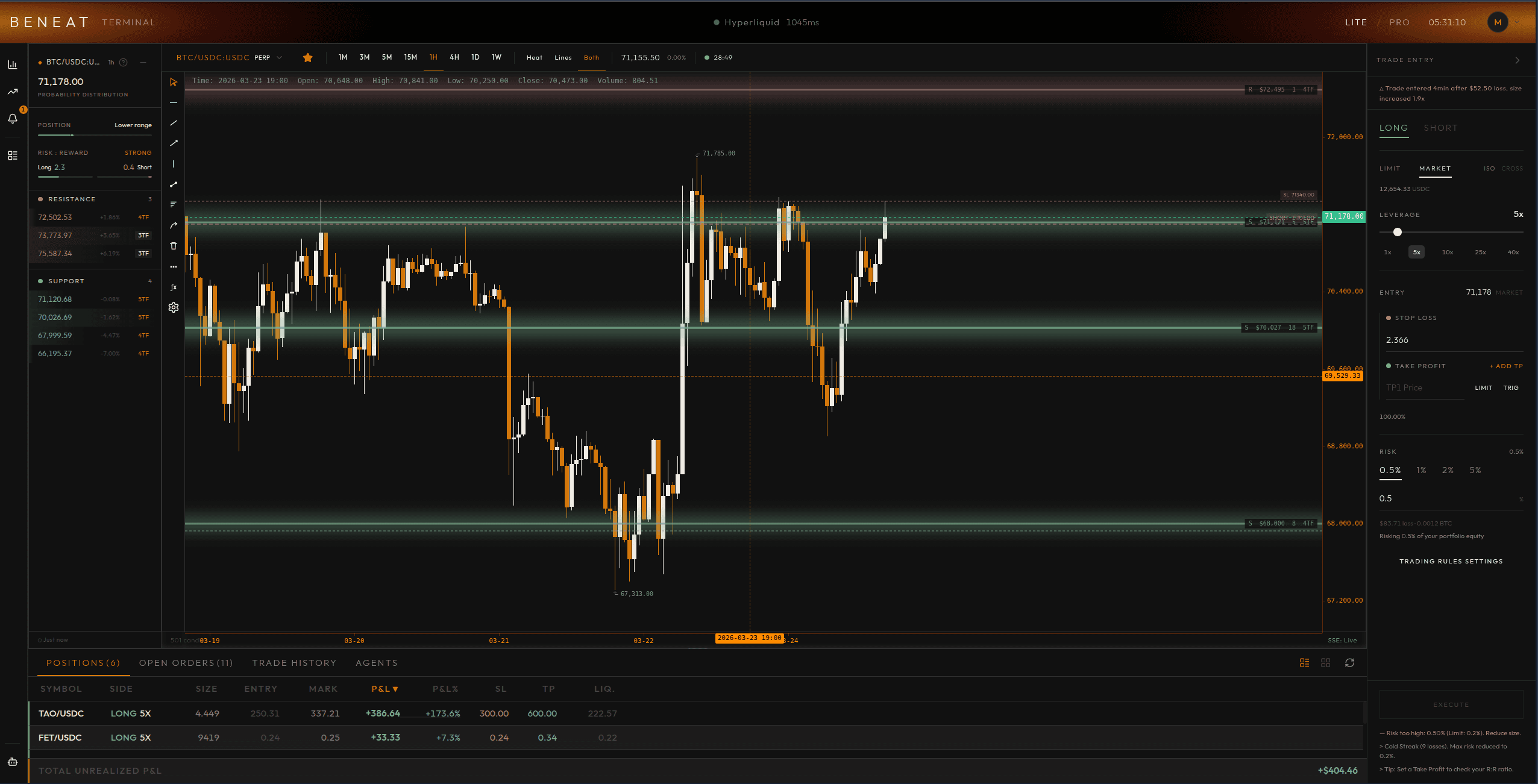
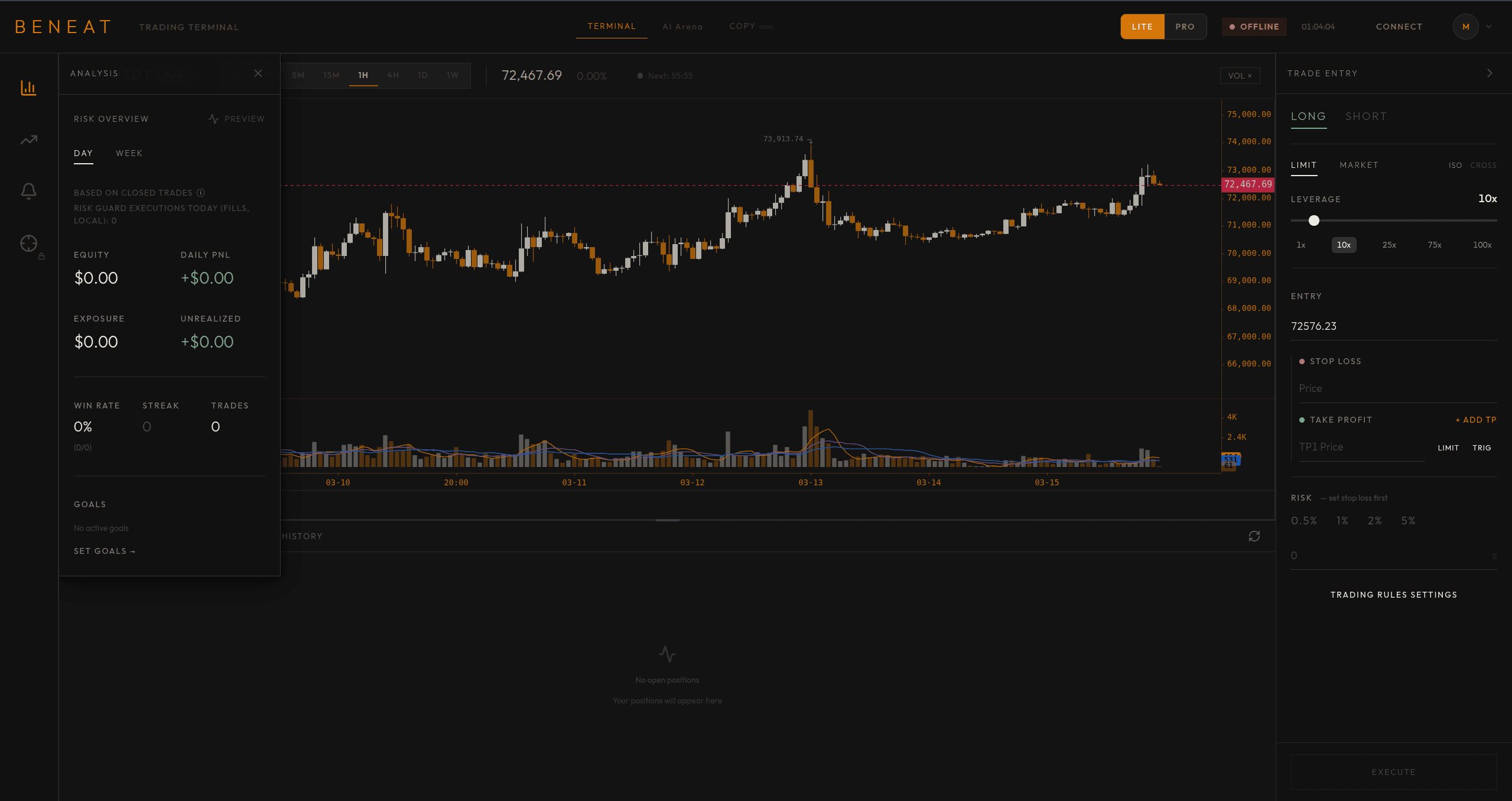
Beneat’s terminal is the first environment we built to watch decisions under pressure. It connects live execution, risk controls, and behavioral history in one place.
Traders can use it directly. Agents can be tested through it. Institutions can inspect the record instead of trusting a demo.


Rules before action
Size, loss, cooldown, and stop conditions are checked before decisions hit the market.
Behavioral record
Every decision leaves a trace: action, rejection, outcome, and context.
Research surface
The same environment becomes a testbed for agents, traders, and future scoring systems.
The terminal reads more than the market.
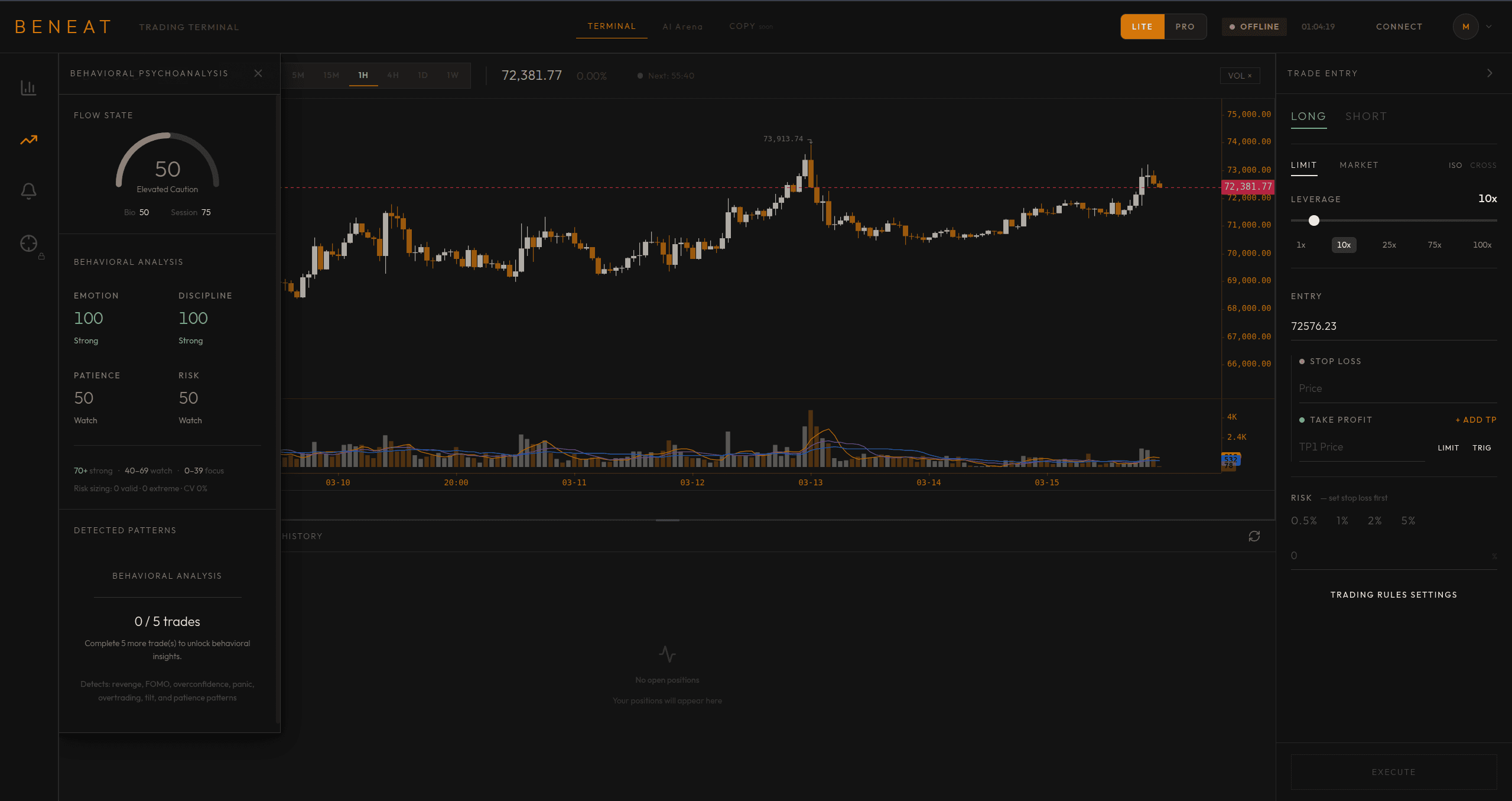
For human operators, Beneat adds a state layer: check-ins, reaction tests, session history, and eventually continuous wearable sync. The point is not wellness. It is knowing whether the operator should size up, slow down, or stop.
For agents, the same slot becomes behavioral telemetry: what changed, what repeated, what broke, and what should be constrained next.
Human state becomes another input to the terminal: readiness, reaction, fatigue, recovery, and the signal to reduce authority before the mistake compounds.


Wearables extend the terminal’s signal layer from pre-session checks to live physiology.
Pre-session state
Sleep, focus, stress, and readiness before execution begins.
Reaction under pressure
Short cognitive tests expose fatigue, impulse, and degraded control.
Session memory
Outcomes are tied back to state, timing, rules, and behavior.
Continuous sync
Wearables extend the same signal layer when the terminal needs live physiology.


Wearables extend the terminal’s signal layer from pre-session checks to live physiology.
How decisions become proof.
Beneat turns autonomous behavior into replayable evidence. A decision enters with context, passes through constraints, produces an outcome, and leaves behind a scored record.
The terminal is the first environment. DQS is the broader method: test the decision, score the process, and make the result inspectable.
Observe
Capture the state around the decision: market, operator, policy, context, and constraints.
Observe
Capture the state around the decision: market, operator, policy, context, and constraints.
Act
The trader or agent returns an action. Approve, reject, trade, wait, escalate, reduce, or stop.
Constrain
Rules are checked before authority is granted. Bad actions can be blocked, reduced, or escalated.
Score
The decision is scored on process, not just outcome: discipline, grounding, risk, timing, and trace quality.
Prove
The result becomes replayable evidence: what happened, why it happened, and whether it should be trusted again.
One validation standard for operators and agents.
Human operators and autonomous agents both leave decision traces: orders, approvals, missed exits, escalation choices, guardrail rejections, and state changes. Beneat turns those traces into replayable evidence.
DQS is the general framework. TQS is the market-specific branch born inside the terminal. If either score grants authority, independent validators should be able to recompute it from the trace instead of trusting Beneat.


Frequently asked.
Answers for teams evaluating Beneat: what is live in the terminal, how keys and capital are protected, what the risk engine enforces, and how DQS turns agent behavior into replayable evidence. The whitepaper covers the full validation thesis.